Workplace wellbeing software
Motikon
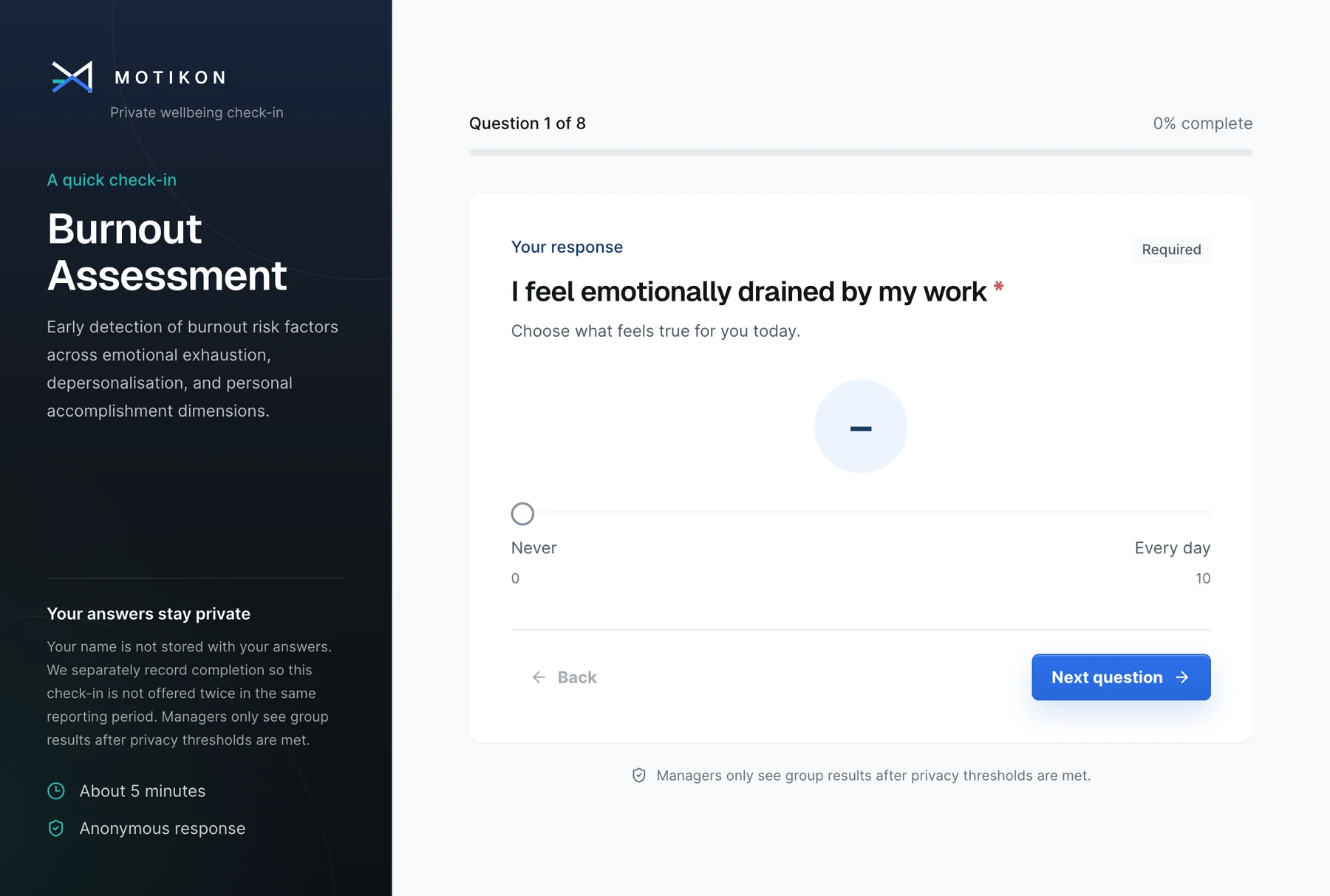
Private wellbeing check-ins for employees, with survey campaigns and reporting for their organisation.
Leaders see which part of the organisation is under stress, and for how long.
- Stage reached
- Working prototype
- Period
- 2025
- Sector
- Workplace wellbeing software
- Organisation
- Motikon
My contribution
I wrote everything from the check-in a staff member fills in to the cohort view a leader reads, and the deployment workflow behind both.
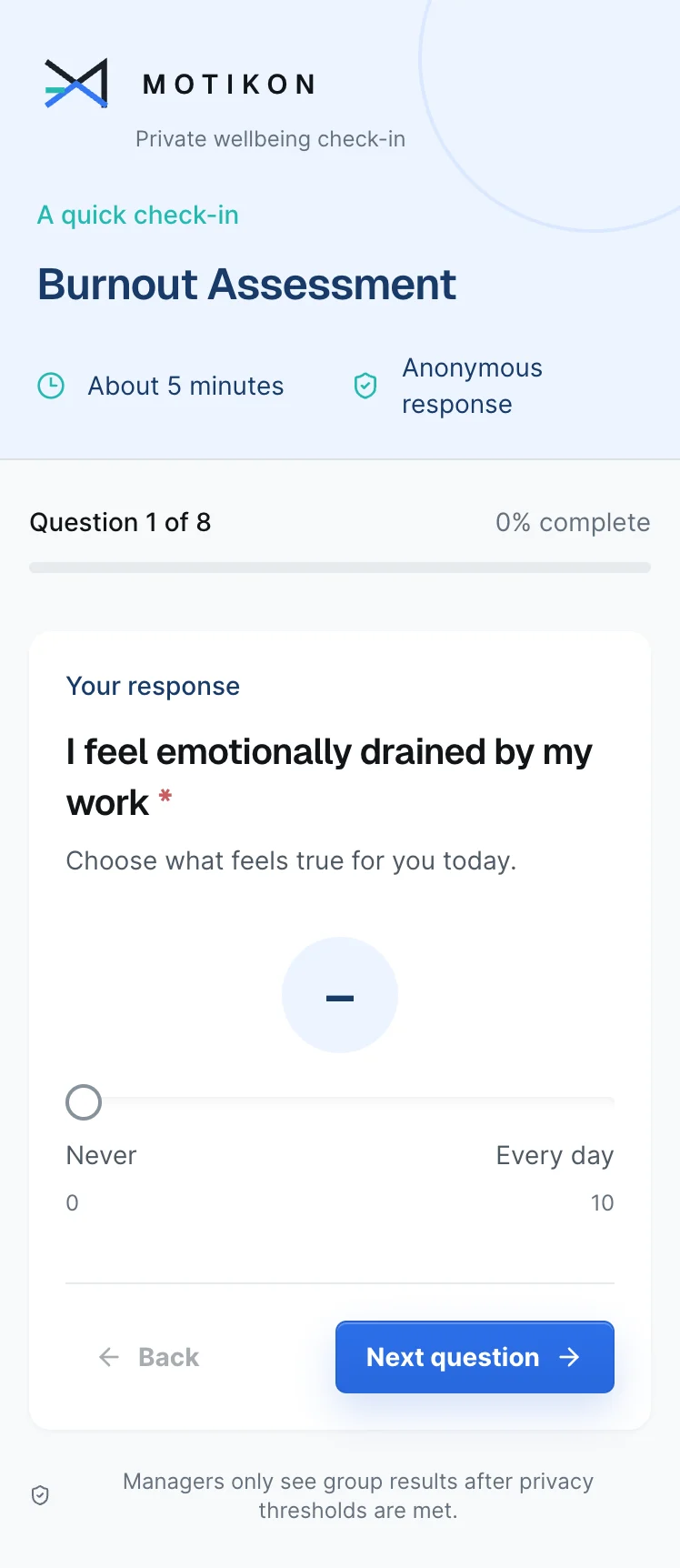
- Employee check-ins and recurring survey campaigns
- Organisation, team and cohort reporting
- A portable application and database deployment
The result
A multi-tenant prototype for repeated surveys and wellbeing reporting over time.
Engagement
Platform engineering and prototype delivery
The problem
A senior leader cannot watch a distributed workforce directly, and a single survey score is noise. They need to know where things are deteriorating and for how long, across departments, sites and care types at once. The catch is that the moment staff believe the tool is surveillance, the data stops being worth collecting.
How it was approached
- Represent organisations, hierarchies and cohorts explicitly in the data model, not as tags.
- Give every campaign its own reporting period, so change over time stays legible.
- Enforce minimum cohort thresholds at the data layer, so anonymity is architecture rather than policy.
- Exercise the application against a fresh database install before calling deployment repeatable.
How far up the stack the work reached
This is an original product. The cohort model, survey engine, analytics pipeline and deployment path were all designed and built here.
Organisation
Departments, sites, teams and the people inside them.
Cohorts
Configurable hierarchy categories, levels and multiple views per org.
Campaigns
Targeted invitations, reminders, completion tracking and closure.
Analysis
Sentiment scoring and theme extraction over structured and open text.
Reporting
Daily longitudinal snapshots, comparisons and alert thresholds.
Deployment
Docker application stack with a reproducible PostgreSQL setup.
Engineering load
Mechanical
Electrical
Embedded
Software
Operations
What was built
Campaign operations
Run surveys as repeatable reporting periods, not one-off sends.
- Cohort-targeted invitations
- Completion and decline tracking
- Reminders and explicit campaign closure
- Role-based access for system admin, org admin and participant
Reporting
Make responses useful across teams and across time.
- Configurable hierarchy categories, levels and nodes per organisation
- Multiple hierarchy views: by department, by site, by care type
- Daily longitudinal snapshots and time-series visualisation
- Alert rules on sentiment score and response-rate thresholds
Portable deployment
Package the app so a fresh environment is a command, not a project.
- Docker application stack
- PostgreSQL schema and migration setup
- Deployment smoke checks and a rollback path
What changed
Multi-tenant
Hierarchies, not flat lists
Organisations define their own cohort categories and levels, and can hold several views of the same population at once.
Anonymity enforced
At the data layer
Minimum cohort thresholds gate display before a result is rendered, so individual responses cannot be reconstructed.
Longitudinal
Trend over snapshot
Each campaign writes its own reporting period and daily snapshots, so a leader sees direction and duration rather than a single score.
Technical stack
TypeScript
React
PostgreSQL
Drizzle
Docker
OpenAI API
Capabilities applied
Product engineering
Data modelling
Reporting systems
Deployment tooling
From the project
Next project
MarineWise
Seller uploads are checked before anyone sees them, in a queue that does not hold up the listing.